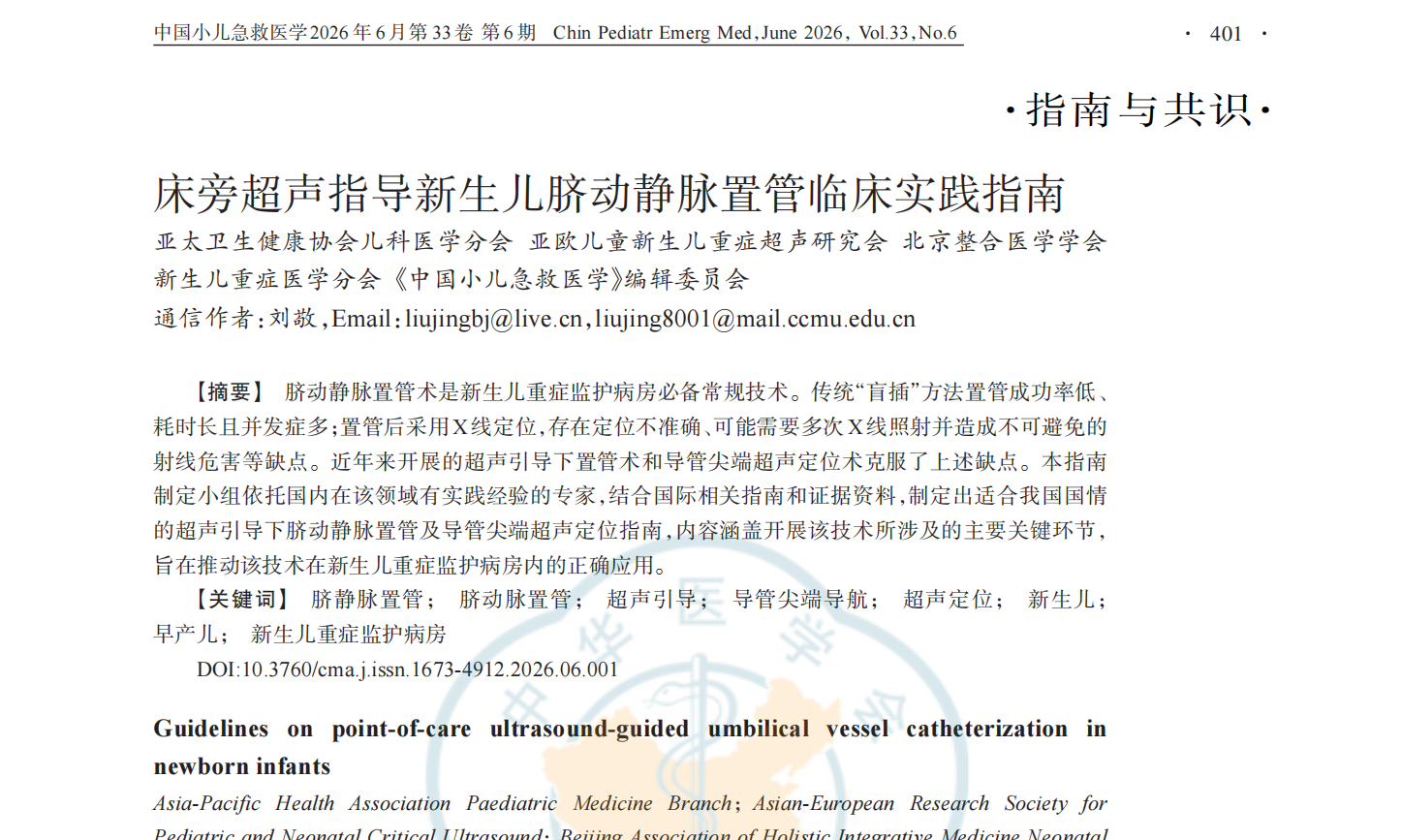
Recently, the "Clinical Practice Guidelines for Point-of-Care Ultrasound-Guided Umbilical Artery and Vein Catheterization in Neonates", jointly organized by the Pediatric Medicine Branch of the Asia-Pacific Health Association, the Asia-Europe Children's and Neonatal Critical Care Ultrasound Research Society, the Neonatal Critical Care Medicine Branch of Beijing Integrated Medicine Society, and the Editorial Office of the Chinese Journal of Pediatric Emergency Medicine, and specifically implemented by the Department of Neonatology of Beijing Obstetrics and Gynecology Hospital, Capital Medical University, was officially published in the Chinese Journal of Pediatric Emergency Medicine, Volume 33, Issue 6, 2026.
Umbilical artery and vein catheterization are common techniques for establishing vascular access in neonatal critical care. Accurate placement of the catheter to the ideal position and rapid, precise localization of its tip are key to ensuring successful catheterization. Although this technique has been used clinically for more than 60 years, there is still no standardized protocol for catheterization, catheter tip position assessment, and catheter management.
Previously, operators typically relied on surface anatomical landmarks to select vessels and insert catheters. This "blind insertion" method is associated with low primary success rates, requiring multiple attempts, and a high incidence of complications. After successful catheterization, confirmation of catheter tip position using X-ray not only prolongs waiting time but also carries the risk of multiple X-ray exposures due to inaccurate positioning. Clinical practice has revealed that even with X-ray confirmation of correct position, the catheter tip may not be ideally placed. In contrast, ultrasound-guided catheter insertion and tip localization effectively overcome these disadvantages: the success rate of catheterization increases from 20%-30% with traditional methods to over 84%, catheterization time is reduced by more than 20%, the error rate of positioning decreases from 76% to 9.6%, and patients are spared from radiation exposure.
To extend the benefits of this technique to more critically ill neonates, the Pediatric Medicine Branch of the Asia-Pacific Health Association, together with the Asia-Europe Children's and Neonatal Critical Care Ultrasound Research Society, the Neonatal Critical Care Medicine Branch of Beijing Integrated Medicine Society, and the Editorial Office of the Chinese Journal of Pediatric Emergency Medicine, jointly organized the development of these guidelines. Chairman Liu Jing of the Pediatric Medicine Branch was responsible for the specific implementation. After more than a year of efforts and repeated revisions by nursing and medical experts with extensive practical experience in this field in China, the "Clinical Practice Guidelines for Point-of-Care Ultrasound-Guided Umbilical Artery and Vein Catheterization in Neonates" adapted to China's national conditions was finally formulated. The guidelines address 10 key clinical issues related to ultrasound-guided umbilical artery and vein catheterization and tip localization, forming 21 recommendations, each with an expert consensus rate exceeding 90%. The content covers all critical aspects of the catheterization procedure. It is believed that the release of these guidelines will play a positive role in advancing the technology of neonatal critical care.
The Chinese Journal of Pediatric Emergency Medicine is a serial journal of the Chinese Medical Association, under the supervision of the National Health Commission of the People's Republic of China. It is one of the source journals for the Chinese Scientific and Technical Papers and Citations Database (CSTPCD), a core journal of Chinese science and technology, and the only specialized academic journal in the field of pediatric emergency and critical care medicine in China.
The guidelines can be freely downloaded and read on the journal's website. We welcome everyone to download, study, and apply them in clinical practice.