APHA (Asia Pacific Health Association) reported on November 29, 2021 that the new variant new coronavirus B.1.1.529 ("Omi Keron") has spread at an alarming rate. The "Omi Keron" that first appeared in Botswana, a southern African country, has spread in many European countries. The British Broadcasting Corporation (BBC) reported on November 28 that the National Institute of Public Health and Environmental Research (RIVM) of the Netherlands confirmed that there were 13 cases of "Omi Keron" variant infections among travelers from South Africa. The Minister of Health of the Netherlands warned that there may be more cases of "Omi Keron" infection in the country. "Washington Post" and "AFP" reported that on the 27th local time, the Dutch Ministry of Health issued a statement stating that 61 of the 600 passengers on the two flights from South Africa to the Netherlands on the 26th tested positive for the new crown virus.
The Dutch government is contacting about 5,000 people in the country who have traveled to southern African countries since November 22, and is asking these people to go to medical institutions to be tested for the virus as soon as possible.
KLM previously responded that the 624 passengers on the two flights from South Africa on the 26th had been checked before boarding the new crown vaccination certificate or nucleic acid test negative certificate, but these passengers had 61 after arriving in Amsterdam. A person tested positive for the new crown virus, and the airlines were also surprised by this, but there is no explanation yet.
At least 9 countries and regions report! Omi Keron strain exposed
Since South Africa reported to the World Health Organization on November 24 that the new coronavirus variant B.1.1.529-Omicron (Omicron), at least Botswana, Belgium, Israel, the United Kingdom, Germany, and Italy have been in 5 days , Hong Kong, Australia and other 9 countries and regions have reported the discovery of this new variant strain. In addition, the Netherlands and the Czech Republic are also suspected of having traces of this mutated strain, and further genetic sequencing of the virus is in progress.
French Minister of Health Verand told the media during an inspection of the new crown vaccination center in the 18th arrondissement of Paris that at present, France has not confirmed the emergence of the new crown virus mutant strain Omi Keron through virus gene sequencing, but in view of the fact that Belgium, Germany, and Italy have already Related cases have been discovered one after another, so he believes that the Omi Keron variant may have spread in France. Verand stated that it may only be a matter of time before the mutant strain is detected in France.
The Health Protection Center of the Hong Kong Department of Health also announced that as of 0:00 on November 28, Hong Kong has newly confirmed 3 new cases of new coronary pneumonia. So far, the total number of cases in Hong Kong has been 12,428 (including 12,427 confirmed cases and one suspected case). The new cases are all imported cases, two involve infections with mutant virus strains, and the test result of the other mutant virus strain is yet to be determined. The case involved three men aged between 37 and 80, all of whom arrived in Hong Kong from designated areas (medium risk) in Group B. One person tested positive while waiting for the transfer in the restricted area of the Hong Kong International Airport, while the remaining two were diagnosed during the quarantine period.
Over 20 countries have taken restrictive measures
The discovery of Omi Kiron strain in South Africa and other countries has aroused high global vigilance. Up to now, the governments of about 20 countries and regions have successively issued or are preparing to introduce entry restrictions on flights and passengers from southern African countries.
Among them, the British government stated on the 26th that from that day onwards, flights from South Africa and the surrounding 5 countries are prohibited from entering, and people with relevant travel history are required to undergo nucleic acid testing and quarantine. Switzerland announced on the same day that all direct flights from Botswana, South Africa and other countries are prohibited from entering the country indefinitely. On November 26, local time, the Italian Ministry of Health has decided to ban entry of people who have stayed in 8 African countries including South Africa and Zimbabwe in the past 14 days.
The German disease control agency has classified South Africa as a "viral mutation area." All people entering Germany from South Africa must undergo a 14-day compulsory quarantine, regardless of whether they have been vaccinated or not.
The Pakistan National Command and Operations Center issued a notice on November 27 that Pakistan issued a travel ban on travelers from South Africa, Lesotho, Swaziland, Mozambique, Botswana, Namibia and other regions.
In addition, Russia also announced that it will ban foreign citizens from South Africa and other countries and regions from entering the country on the 28th of this month.
According to US media reports, the US government will begin to impose travel restrictions on citizens from seven countries including South Africa on the 29th of this month. Health Canada also announced on the 26th that it will prohibit entry of foreign citizens who have been to southern African countries in the past 14 days.
Israel has banned its citizens from traveling to Southern Africa after discovering cases of infection with new mutant strains in its territory. On the 28th local time, Israel decided to ban all foreigners from entering the country. The ban will last for 14 days.
Singapore and Malaysia respectively announced on the 26th that they would prohibit the entry of travelers who have recently visited South Africa and other seven countries. The Indian government issued a reminder that local governments should implement new coronavirus tests and health screenings for international travelers from South Africa and other "risk zone" countries. Japan has also implemented measures to suspend inbound flights and isolate passengers from South Africa and other countries. Regarding the travel bans issued by many countries around the world, the South African government responded on the 26th that imposing travel restrictions on travelers from South Africa is harsh and unscientific, and this approach is also inconsistent with WHO's recommendations. The South Korean epidemic prevention department announced that from 0:00 on the 28th, foreigners from 8 countries including South Africa are prohibited from entering the country to prevent the new crown mutant strain "Omi Keron" from entering the country. South Korea has not yet found a case of "Omi Keron" infection.
Experts from various countries analyze and judge:
On November 28, local time, according to a report by USA Today, American infectious disease expert Fauci said that the new type of new coronavirus in Ome Keron may have spread in the United States.
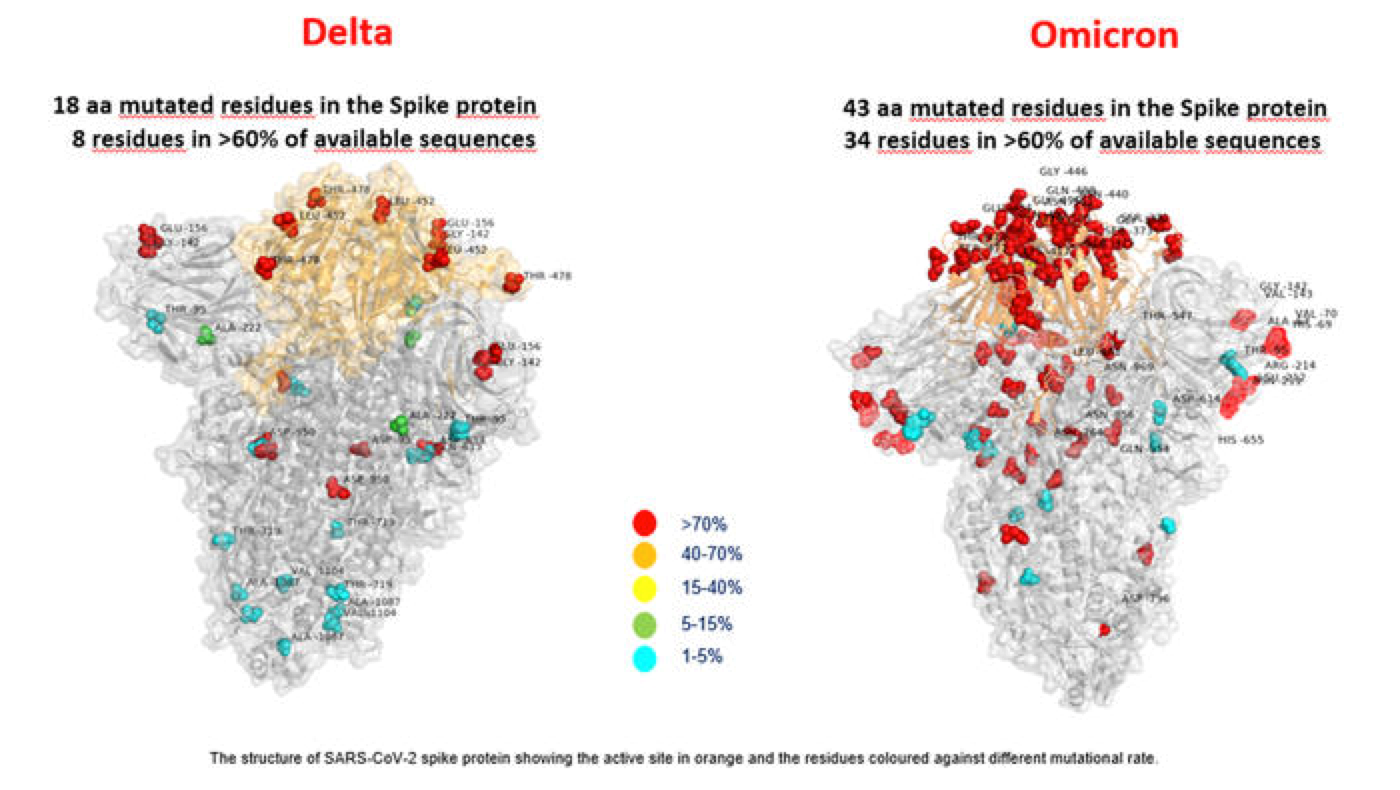
On November 26, local time, Ding Liang, a Chinese epidemiologist and senior researcher of the American Federation of Scientists, issued an article pointing out that compared with the highly disseminated Delta variant, the number of "bad thorn mutations" in the new variant was one more than that of Delta. Times.
He wrote: "The B.1.1.529 variant may have a powerful 500% infectious power, which is by far the most shocking number."
On November 27, local time, the scientific research team of the Children's Hospital of Rome, Italy released the world's first picture of Omi Keron. The picture shows that Omi Keron has more spike protein mutations than the new crown mutant virus Delta.
According to the WHO, Omi Keron has many genetic mutations that may cause it to spread rapidly. Compared with other new coronavirus variants, the virus causes the human body to increase the risk of re-infection with the virus. WHO officials also said that little is known about this new coronavirus, and more experimental data are still needed to assess whether it is more infectious or more resistant to vaccines.
"Because of the lack of relevant research data, no one has a complete understanding of it. It is not yet clear how much threat it poses.
According to a report from the "Daily Telegraph" on November 27, local time, the president of the South African Medical Association, Angelique Couche, said that the symptoms of Omi Kejon were "unusual but very mild." "Omi Keron causes mild illness. The symptoms include muscle soreness, fatigue, and a slight cough. So far, we have found that the infected person has not lost their sense of taste and smell, and there are no obvious symptoms.
Michael Ryan, Executive Director of WHO's Health Emergencies Program, said at the press conference: "Viruses will continue to evolve. This situation will always happen, and we will find them." But he still hopes that the public will not worry too much about the new coronavirus mutant. .
William Hanach, an epidemiologist at the Harvard School of Public Health in the United States, said: "Omi Keron may have an impact on the effectiveness of the vaccine, but further research is needed to determine how much the effectiveness of the vaccine will be reduced."
British scientist Andrew Pollard said in an interview with the BBC that he believes that the new virus is "very unlikely" to spread as quickly as Delta before, and he believes that a vaccine against the new virus can be developed "very quickly".
Nan-shan Zhong: The harm of Omi Keron still needs some time to judge
On November 28, Academician Nan-shan Zhong stated that Omi Keron spreads faster: "This mutant strain (Omi Keron) is very new, although molecular genetic testing has found that it has more changes in the receptor binding site. But how harmful it is, how fast it will spread, whether it will make the disease more serious, and whether it is necessary to develop a vaccine against it, but also to judge according to the situation, it is too early to draw a conclusion. The Omicron mutant strain It will take some time to judge the hazard and need to pay attention to it at any time, but no major action will be taken now. Another thing that needs more attention is the prevention and control of personnel from relevant places in South Africa."
Wen-hong Zhang, head of the Shanghai New Coronary Pneumonia Clinical Treatment Expert Team and Director of the Department of Infectious Diseases of Huashan Hospital Affiliated to Fudan University, said on the 28th, “This time the emergence of the variant virus in South Africa is accidental, but will it constitute an immune system for the currently preliminarily established vulnerable population? Threats require observation time of about two weeks."
He pointed out that the new mutant strains will not have a big impact on China at present. China's current rapid response and dynamic reset strategy can cope with various types of new crown variants.
Wen-hong Zhang explained that once it is clear that the Omi Kiron strain can break through the original immune barrier, it means that we must adjust all the existing vaccine systems and begin to enter the influenza vaccination mode, which means that we must be based on the virus every year. Mutations, the rapid construction of new vaccines; it also means that life will become more difficult. The full text is as follows: The Shanghai epidemic has entered a phase-out phase. The new variant of the new crown Omi Keron landed in the world and quickly occupied all academic forums and common people's dining halls. A few views for your reference:
1. The discovery of the Omi Keron variant is a recent emergency, and it is undoubtedly a product of virus evolution. Since the number of mutation points far exceeds all the variants that have been discovered, it is expected to be formed after a long period of evolution in the host. Because the new coronavirus causes an acute infection, it is difficult to survive and evolve for a long time in people with normal immune function, and there is no gene rematch discovery like influenza virus. At present, most people think that this variant may be in people with immune function defects, such as AIDS patients. After a long period of time in the body, it eventually evolved. After the formation of the new variant, it spread by chance and quickly surpassed the existing virus transmission capacity in transmission, becoming the dominant strain (more than 90%) among the virus strains recently recorded in South Africa.
2. Due to the many mutation points of the virus, it seems to have defeated other virus strains in South Africa in the short term, including the Delta strain. Therefore, out of caution, the World Health Organization has listed it as a variant strain (VOC), which means that it will cause great concern.
3. But does this mean that the global anti-epidemic efforts have lost all previous efforts? It's hard to say now. The total number of virus strain sequences announced in South Africa this time is not large, and more data and laboratory data in the next two weeks are needed to make accurate judgments.
4. South Africa has a low completion rate of vaccination. Only 24% of the population completed the entire vaccination process. The natural infection rate is about 4.9%. In fact, it is not enough to build an immune barrier between vaccines and natural infections. Without an immune barrier, there is no immune breakthrough. In other words, if this situation occurs in Israel today, it can be said that there is no doubt that the global fight against the epidemic will face the risk of a new start.
5. It is also clear here why the vaccination rate of these vaccines in the United Kingdom and Israel has exceeded 80%, especially the third dose vaccination rate in Israel has reached about 50%. The measures taken by these two countries for foreign imports have suddenly tightened . In other words, in the case of South Africa, if it is clear that this virus strain can break through the original immune barrier, it means that we must adjust all the existing vaccine systems and begin to enter the influenza vaccination mode, which is It is said that a new vaccine should be quickly constructed every year based on the mutation of the virus. But it also means that life will become more difficult.
6. Under this circumstance, it can be judged that the emergence of the variant virus in South Africa is accidental, but whether it will pose a threat to the immunity of the currently initially established vulnerable population, it will take about two weeks of observation time. Why is it initially set within two weeks? Because the current global epidemiological data and virus neutralization test data will produce results within two to several weeks. These tasks are being carried out simultaneously by our Fudan team and many fraternal scientific research teams in China. But I agree with my friend Professor Jin Dongyan, a virologist at the University of Hong Kong, "The mutation of the new crown virus is subject to certain restrictions. In general, many variants of the new crown have not survived, even some of the survived variants. Only a few can become dominant strains. From the outbreak to the present, at least hundreds of variants have been found, but only one delta can stay. In the past, beta and gamma variants have also been shown to have relatively strong immunity. Escape features, but they still lost in the spread game against Delta, and finally disappeared silently. "Let's wait and see, but it doesn't take too long.
Finally, let’s talk about what China will do. I don't think it will have a big impact on China at present. China's current rapid response and dynamic zeroing strategy can cope with various types of new crown variants. The new crown virus changes again, and it is still a new crown virus. China is currently in a period of strategic opportunities won by the dynamic zero-clearing strategy, and is accelerating the construction of the scientific support required to deal with the normalized epidemic in the next stage, including the formation of effective vaccines and drug reserves that can support the opening of the world, as well as public health and medical resources reserve. Based on science and solidarity, we can deal with Delta and Omi Keron.
Zun-you Wu: Measures such as wearing a mask are effective for all mutant strains
On November 28th, Zun-you Wu, chief epidemiologist of the Chinese Center for Disease Control and Prevention, stated that the containment "clearance" policy is China's "magic weapon" for controlling the epidemic, and this "magic weapon" is very effective; as long as it adheres to normalized prevention and control Measures can prevent the spread of Omi Keron strain.
The global epidemic is unevenly distributed. The key countries of the epidemic account for 60% of the total global epidemic, of which up to 10 countries account for more than 150 million, accounting for 60% of the world. "The mathematical model shows that Omi Keron is more infectious than Delta. We have already felt that Delta is more infectious. It spreads fast, but one thing is clear. No matter how the mutation, our public health measures All are effective." He said that public health measures such as wearing masks and maintaining social distancing are effective for all mutant strains.
Bo-li Zhang: We have to take measures from six aspects
Bo-li Zhang, an academician of the Chinese Academy of Engineering, pointed out on November 27 that there is a trend of accelerated virus mutation in the world, and we need to take measures from six aspects. Strengthen monitoring and tracking, establish a sequence database, increase the frequency and quantity of sequencing, and report important mutations in a timely manner; establish a national-level virus strain library, infectious serum and antibody library, study the driving factors of virus mutation, and establish virus phenotype, transmission capacity, Research methods for pathogenicity and vaccine escape, clarify the pathogenic mechanism of the virus; improve the convenience and accessibility of detection, establish a technical platform for identification and rapid detection of mutant strains, and do a good job in rapid detection of mutant strains.
Multiple vaccine manufacturers have begun to respond to Omi Keron
At present, many vaccine manufacturers have stated that they are studying the impact of Omicron on the vaccine, and some manufacturers have begun to respond.
It was learned from Kansino Biological Co., Ltd. on the 28th that Kansino Biological is highly concerned about the mutant strain of "Omi Keron" and is currently collecting and analyzing information related to the mutant strain. It is understood that CanSino Bio has begun to develop vaccines against new mutant strains. The relevant person said, "In view of the advantages of CanSino Bio's adenovirus vector technology platform and mRNA technology platform, once it is found that the protection of existing vaccines has decreased, CanSino has Confidence to come up with a new vaccine against the mutant strain in the shortest time."
Modena Chief Medical Officer Paul Burton (Paul Burton) said that he suspects that the new crown virus variant "Omi Keron" has the ability to escape the existing vaccine. If so, the new crown vaccine against the Ome Keron variant may be possible. It will be available in early 2022. Modena previously discussed plans to deal with Omi Keron mutant strains, including a new candidate vaccine numbered mRNA-1273.529 against the mutant virus. The company said that it is testing three new crown vaccine candidates for this variant. Modena said that Omi Keron has mutations that appear in the Delta variants that are believed to increase transmission, as well as mutations in the Beta and Delta variants that are believed to promote immune escape. The company said that the combination of these mutations poses a significant potential risk for accelerating natural and vaccine-induced weakening of immunity.
According to the Beijing Daily, Kexing pays close attention to the information related to the Omicron variant of the new coronavirus. It has started to actively collect and obtain information and samples of the new variant through the global partner network. Evaluation and research will be carried out as soon as possible to understand the effect of the Omicron strain on the existing strain. The impact of the new coronavirus inactivated vaccine and the necessity of developing a variant vaccine. Kexing said that the company has mature vaccine production technology and large-scale production capacity, and has previously carried out the development of new crown inactivated vaccines against the Gamma strain and the Delta strain. If necessary, the company can quickly advance the development and mass production of new vaccines, and has the ability to guarantee vaccine demand.
AstraZeneca said the company is conducting research in two southern African countries, Botswana and Swatini, to collect data, which will enable the company to collect real-world data on this mutant strain. AstraZeneca also stated that the company has developed a vaccine platform in cooperation with Oxford University to quickly respond to new variants. The vaccine platform was created at Oxford University. The company has previously stated that it is developing a variant vaccine to better target Beta variants.
Pfizer and BioNTech previously stated that they are investigating the new variant of the new coronavirus Omicron (B.1.1.529). The two companies expect to have more experimental data within two weeks at the latest. The two companies said: "These data will provide more information about B.1.1.529. If the variant spreads globally, we may need to adjust the vaccine." Pfizer and BioNTech pointed out that they can do so within six weeks. Adjust its mRNA vaccines and start shipping them in batches within 100 days. Johnson & Johnson said they are already testing its vaccines to deal with new variants. The company said: "We are closely monitoring the emerging new coronavirus strain with the SARS-CoV-2 spike protein mutation, and are already testing the effectiveness of our vaccine against the rapidly spreading new coronavirus that was first discovered in South Africa. ."
This article is edited and compiled by APHA(Asia Pacific Health Association). Comprehensive news comes from: World Health Organization, China National Health Commission, "BBC", "Global International News", "USA Today", "Daily Telegraph" Newspaper, Beijing Daily, Euronews, Washington Post, AFP