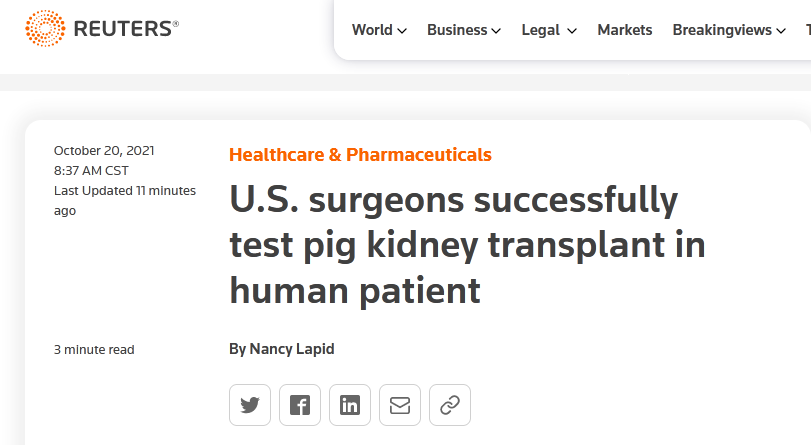
According to a Reuters report on the 19th, NYU Langone Health performed surgery last month. The patient was brain dead and showed signs of renal insufficiency. After obtaining the consent of the patient’s family, the doctor connected a pig kidney to a pair of large blood vessels of the patient, leaving the pig kidney outside of the patient to observe the effect of the operation.
Chief surgeon Robert Montgomery said that because the transplanted pig kidney was genetically modified, the operation did not immediately cause rejection. After being connected to the patient's blood vessel, the pig kidney functions normally to filter waste and produce urine, and the level of urination is equivalent to that of the transplanted human kidney. The patient's creatinine level was abnormal before surgery and returned to normal after transplantation. The level of creatinine is one of the indicators to measure whether the kidney function is healthy.
He said that a sugar molecule called alpha-gal in pig cells can cause human rejection, and the "kidney source" of this operation is a pig that has been genetically modified to remove this sugar molecule, so the patient did not show up. Rejection.
Three days after the transplant operation, the patient's life support equipment was removed on the scheduled date.
The Associated Press quoted Montgomery as reporting that the patient wanted to donate organs during her lifetime, but for some reason her family agreed to let her receive a pig kidney transplant, which allowed her to contribute to medical research in this way.
Pigs have always been the latest research focus to solve the problem of organ shortages, but there are also some obstacles: the sugar from pig cells is foreign to the human body and will immediately cause organ rejection. This pig was genetically edited by Revavicor and was approved by the FDA as a source of human therapy. According to the company's previous public information, its technology knocks out the protease that adds α-galactose on the surface of pig cells, so that pig cells no longer express α-galactose, reducing human rejection.
Montgomery said that the current trial only involves a single kidney transplant, and the kidney is only kept outside the body for three days, so any future trials may find new obstacles that need to be overcome.
Human trials are expected
Dr. Montgomery said that this operation and previous studies have made it possible for patients with advanced renal failure to receive experimental pig kidney transplantation as early as one or two years. This may become a short-term solution for critically ill patients with acute kidney source shortage, or even a long-term solution.
Reuters quoted data from the Organ Sharing United Network, a non-profit organization in the United States, reporting that there are currently nearly 107,000 people in the United States waiting for an organ transplant, of which more than 90,000 people are waiting for the source of the kidney, which takes 3 to 5 years on average.
Dr. Montgomery received a heart transplant three years ago. He said: "I used to be one of those people. They were lying in the intensive care unit waiting for their organs to be donated. I don't know if they can get them in time."
Research on transplanting animal organs to humans has been underway for a long time. According to the Associated Press, in the 1980s, a critically ill baby in the United States received a baboon heart transplant and died 21 days after the operation.
According to the assessment of Professor ZhangHua from the Nephrology Branch of the APHA Asia-Pacific Health Association, Chinese researchers are also exploring the possibility of animal organ transplantation. After transplanting animal organs to humans, it successfully overcomes the hyperacute (within 48 hours) rejection that will inevitably occur in organ xenotransplantation from animals to humans. This means that it can be used at least as a short-term transition. The next step is to To study the effects of accelerated rejection (48 hours-5 days), acute rejection (more than one week) and chronic rejection. "
Zhang Hua believes that there is less ethical controversy about organ transplantation trials for brain-dead patients, but whether the trial can be expanded to normal patient groups in the future still needs to obtain more scientific data about the trial.
He cited data as saying that there are more than one million uremia patients in China. The latest data show that there are 700,000 registered hemodialysis patients in China, and there is a huge demand for kidney donors. Zhang Hua said that although China has developed rapidly in the field of clinical organ transplantation, there is still a certain gap between China and the United States in terms of basic research. "So I have always called for the need to be in line with international standards and strengthen investment and exploration of basic technology in organ transplantation." Zhang Hua said.
据路透社19日报道,纽约大学兰贡医疗中心(NYU Langone Health)上月实施了手术。患者已经脑死亡,出现肾功能不全迹象。征得患者家属同意后,医生把一个猪肾连接到患者的一对大血管上,猪肾留在患者体外,用于观察手术效果。
主刀医生罗伯特·蒙哥马利(Robert Montgomery)说,由于移植猪肾经过基因改造,手术没有立即引起排异反应。与患者血管相连后,猪肾正常发挥过滤废物、产生尿液的作用,排尿水平与移植人类肾脏相当。患者手术前肌酐水平异常,在移植后恢复正常。肌酐水平是衡量肾功能是否健全的指标之一。
他说,猪细胞中一种名为alpha-gal的糖分子会引起人体排异反应,而这次手术的“肾源”是一头经基因改造、去除这种糖分子的猪,因此患者没有出现排异反应。
移植手术后3天,患者生命支持设备按预定日期去除。
美联社援引蒙哥马利的话报道,患者生前希望捐献器官,但出于某些原因无法实现,其家人因此同意让她接受猪肾移植,以这种方式让她为医学研究做出贡献。
猪一直是解决器官短缺问题的最新研究重点,但也存在一些障碍:来自猪细胞的糖对人体来说是外来的,会立即引起器官排斥。而这头猪由Revivicor公司进行基因编辑,并获得了FDA的批准作为人体疗法的来源。依照该公司之前的公开信息,其技术敲除了在猪细胞表面添加α-半乳糖的蛋白酶,从而让猪细胞不再表达α-半乳糖,减少人体排斥反应。
蒙哥马利说,目前的试验只涉及单个肾脏移植,且肾脏仅在体外保留了三天,因此未来的任何试验都有可能发现需要克服的新障碍。
有望开展人体试验
蒙哥马利医生表示,这次手术及先前研究让肾衰竭晚期患者有望实验性接受猪肾移植,最早在一两年内实现。这可能成为重症患者急缺肾源的短期解决方案,甚至可能成为长期方案。
路透社援引美国非营利机构器官共享联合网络组织数据报道,美国现有近10.7万人等待器官移植,其中9万多人等待肾源,平均3到5年才能等到肾源。
蒙哥马利医生3年前接受了心脏移植。他说:“我曾经是那些人中的一员,他们躺在重症监护室里等待捐献的器官,不知道能否及时得到。”
把动物器官移植给人类的研究已经开展相当长时间。据美联社报道,20世纪80年代,美国曾有一名病危婴儿接受狒狒心脏移植手术,在手术后21天去世。
据亚太卫生健康协会(APHA Asia-Pacific Health Association)肾脏病学分会张华教授评估 ,中国研究人员也正在探索动物器官移植的可能性。在动物器官移植到人体后,成功克服了从动物到人体的器官异种移植必然会发生的超急性(48小时内)排异反应,这就意味着至少可以作为短期过渡来使用,下一步就是要研究加速性排异反应(48小时-5天),急性排异反应(一周以上)和慢性排异反应的影响。”
张华认为,对脑死亡患者去做这样的器官移植试验在伦理方面的争议较小,但是未来是否能够将试验扩大到正常患者群体,仍然需要获得更多关于试验的科学数据。
他援引数据称,中国目前尿毒症患者超过一百万人。最新数据显示,中国登记血透患者就有70万人,对于肾脏供体需求巨大。张华表示,尽管我国在临床器官移植领域发展迅速,但在基础研究方面,与美国相比还有一定差距。“所以我一直呼吁应该与国际接轨,加强器官移植基础技术的投入和探索。”张华说道。
(Compiled by the Propaganda Office of the Asia-Pacific Health Association - APHA亚太卫生健康协会 宣传处整理)